


Table of Contents
In the modern corporate landscape, capital expenditure is under more scrutiny than ever. Traditional fixed displays, once the standard for boardrooms and lobbies, are increasingly viewed as sunken assets due to their high installation costs and limited utility. Enter the portable screen on wheels: a high-agility alternative that redefines equipment ROI.
This article provides a comprehensive use-case analysis of how mobile smart screens, such as the GFF S1, achieve full financial payback in as little as six months. By slashing infrastructure costs, tripling asset utilization, and accelerating revenue-driving activities, these units transform from simple hardware into essential profit centers.
The Hidden Costs of Fixed Displays
When a business purchases a traditional 75-inch or 85-inch display, the sticker price is only the beginning of the financial commitment. The Total Cost of Ownership (TCO) for fixed displays is often inflated by three primary hidden factors that erode ROI from day one.
The Installation and Labor Costs
Getting a commercial screen on the wall costs more than just the hardware. For 85-inch units that weigh over 100 lbs, businesses often need wall reinforcement, professional calibration, and electrical work done before the screen ever powers on. Add contractor scheduling into the mix, and what should take a day or two can drag out for weeks.
According to 2026 industry pricing guides, professional commercial display installation can range between $150 and $800 per screen, depending on the wall material and cable routing complexity. When a room needs new electrical drops or data ports to meet fire codes, the bill can easily top ~$1,500 per room. Once that money is spent, it doesn't come back. If the office layout shifts or the lease runs out, every dollar put into wiring and mounting stays behind in those walls.
The Asset Under-Utilization Problem
A fixed display is a prisoner of its geography. In most corporate environments, conference rooms are occupied for an average of 15 to 20 hours per week. This means a $3,000 asset sits idle and unproductive 80% of the time. This utilization gap is a silent killer of ROI. Organizations essentially pay a premium for technology that spends most of its lifecycle powered off in an empty room.
To compensate for this lack of mobility, businesses often over-purchase hardware, buying one screen for the breakroom, one for the lobby, and one for the boardroom, simply because the assets cannot move to where the people are. This leads to a bloated capital budget where the cumulative idle time represents thousands of dollars in wasted potential.

Maintenance and Remodeling Friction
The modern office is fluid, yet fixed AV is rigid. When a company decides to transition to an open-plan layout or reconfigure its reception area, fixed displays become a logistical liability. Moving a mounted TV requires hiring contractors to de-install the unit, patch and paint the old site, and repeat the expensive wiring process at the new site.
This lack of agility creates a flexibility tax that discourages innovation in office design. Portable displays, by contrast, facilitate dynamic space management, allowing the furniture and tech to evolve alongside the team’s needs without requiring a work order.
The ROI Math: The 6-Month Payback Model
To understand how a mobile display pays for itself, we must compare the Cost per Effective Hour of a fixed unit versus a high-performance mobile unit like the GFF S1. These figures account for standard commercial depreciation and energy consumption rates.
| Cost Category | Fixed Display (3 Units) | GFF Mobile Smart Screen (1 Unit) |
|---|---|---|
| Hardware Purchase | $3,600 ($1,200 x 3) | $899 |
| Installation & Wiring | $1,500 ($500 x 3) | $0 (Plug & Play) |
| Utilization Rate | 20-30% (Single Room) | 80-90% (Multi-Use) |
| Year 1 Total Cost | $5,100 | $899 |
Analyzing the Asset Utilization Rate
The six-month payback model is validated by the high utilization rates seen with mobile units like the GFF S1, which can effectively replace three separate fixed installations by following the flow of office activity.
To visualize how one device achieves such high efficiency, consider a typical workday:
- 08:00 – 10:00: The unit serves as a digital welcome board in the lobby, greeting clients and displaying safety protocols.
- 10:30 – 12:30: The unit is wheeled into a huddle space for a rapid strategy session, serving as an interactive whiteboard.
- 13:00 – 15:00: It moves to the break area for a training webinar or a town hall broadcast.
- 15:30 – 17:00: It acts as a side-monitor for a lead developer in a temporary workspace.
By concentrating the investment into one high-quality, mobile asset that is used 8 hours a day rather than 2, the Cost per Productive Hour drops by nearly 75%. This efficiency allows the device to reach its break-even point in approximately 180 days based on saved infrastructure and hardware costs alone.
Three Pillars of Financial Efficiency
Infrastructure Savings and Trade Interruption
Mobile screens eliminate the need for Trade Interruption. In a traditional setup, installing a screen involves noise, dust, and the scheduling of multiple contractors, including electricians, painters, and AV techs. This leads to downtime in the specific rooms being outfitted.
A portable screen is a zero-touch deployment. Since these units run on built-in batteries and carry strong Wi-Fi connectivity, they work in spots where running cables would cost too much to justify. For startups or businesses in short-term coworking spaces, that means no capital gets tied up in permanent changes to a building they don't own.
Operational Agility in Hybrid Work
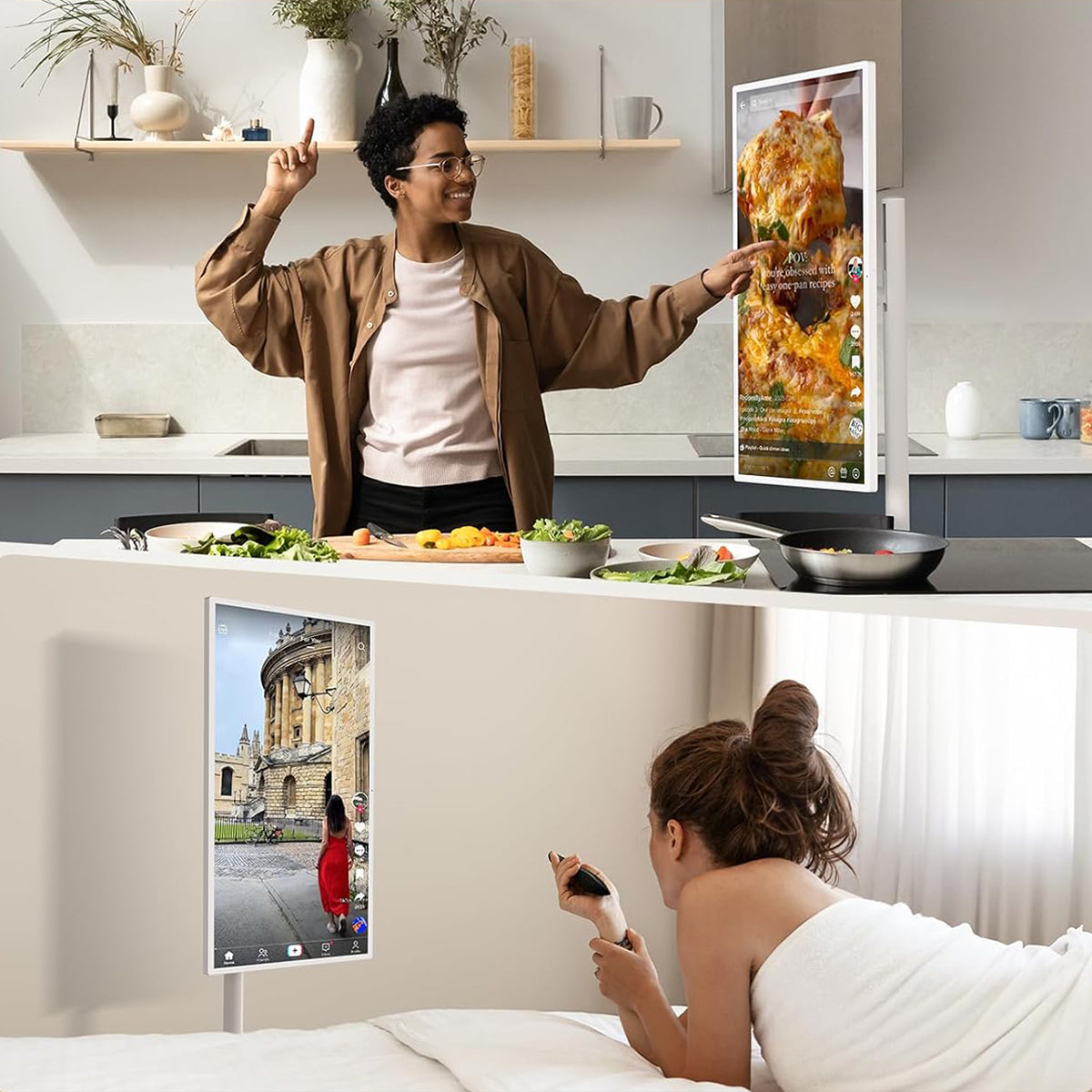
In a hybrid work environment, the huddle happens anywhere. Operational efficiency is gained when technology doesn't dictate where work happens. A mobile display allows teams to turn any corner of the office, even a lounge or an outdoor patio, into a high-tech collaboration zone instantly.
This reduces meeting room friction, which is the lost productivity spent by employees searching for a room with a working screen. Research shows that 25% of meetings are delayed due to technical issues, with an average of 2.7 minutes of every meeting lost as a result. By bringing the screen to the team, rather than forcing the team to the screen, businesses reclaim hundreds of billable hours per year.
Revenue Acceleration via Customer Engagement
Beyond saving money, portable screens make money. In retail, automotive showrooms, or real estate offices, a mobile screen can be positioned at the Point of Decision to showcase promotions or interactive catalogs.
Industry data from 2026 shows that interactive digital signage can increase customer engagement for up to 64% of businesses that use it, and impulse purchases by nearly 20%. The ability to move a 4K presentation tool directly in front of a prospective client during a walk-in visit is a conversion driver that fixed screens, stuck behind a reception desk, cannot replicate. In a sales context, the GFF S1 acts as a digital closure, providing visual proof and interactive data that speeds up the sales cycle.
Risk Mitigation: Why Mobile Assets Protect Your Capital
Investing in fixed assets carries location risk. If a business outgrows its space or needs to pivot its building model, fixed technology is often abandoned or sold at a massive loss because removal costs exceed the asset's residual value.
Capital Protection and Liquidity
A portable TV on wheels is a liquid asset. If you move offices, you simply roll the screen into the moving truck. There is no damage to the walls of the old office (avoiding make-good costs in lease contracts) and no new installation costs at the destination.
Furthermore, mobile units are easier to sell on the secondary market. A buyer can pick up a rolling screen and put it to work immediately, whereas a mounted screen requires professional removal, which decreases its resale value. This liquidity ensures that your capital isn't locked into a specific wall or building.
Future-Proofing and Lifecycle Management
Display technology moves fast; most hardware is outdated within 3 to 5 years. With a fixed installation, that upgrade cycle gets expensive fast. A new screen might not fit the existing bracket, and newer ports often mean new cabling, which pulls in more labor costs on top of the hardware.
With a mobile unit like the GFF S1, the upgrade cycle is isolated. When a more advanced model is released, you simply replace the unit. No walls get touched, no cables get pulled, and no contractor needs to show up. That alone cuts a significant chunk from the upgrade cost. Businesses can swap in a newer unit and be up and running the same day, staying current with display technology without the recurring costs that come with fixed setups.
Conclusion & Call to Action
The 6-month payback period for a portable screen on wheels is not a theoretical projection; it is the logical result of eliminating wasted installation capital and maximizing asset utilization. By replacing static, underused hardware with a versatile, high-performance mobile unit, businesses gain the agility required for the 2026 economy.
Choosing a mobile solution means your budget goes toward actual work rather than walls and wiring. It's not just a screen, it's a piece of infrastructure that moves with the business, adapts to new spaces, and doesn't become a liability when the office changes. For companies that want their tools to keep up with how they actually operate, that kind of flexibility matters. Maximize your office ROI today.