

Table of Contents
A portable touch screen TV is the safer and smarter kitchen screen because it stands on its own, sits at eye level, and doesn't need your greasy hands to keep it awake. An iPad works, sure. But it's a small tablet you're constantly leaning against a flour bag, wiping with a tea towel, and touching between handling raw chicken and chopping salad.
Anyone who cooks a lot knows the routine. Recipe on the tablet. Tablet propped against the toaster. The screen goes dark right at step four. Hands covered in oil. You tap it anyway.
There's a better setup.
Why Does Propping Up an iPad in the Kitchen Go Wrong?
It's not that tablets are bad. It's that kitchens are hostile places for them.
Think about what actually happens on a busy countertop:
- The screen sleeps mid-recipe. You wake it with dirty fingers, or you keep drying your hands over and over.
- It falls over. A tablet propped on a stack of cookbooks isn't stable. One elbow and down it goes.
- Steam, splashes, and heat. Water near ports, oil mist on the glass, a hot pan too close.
- It's small. Squinting at a 10-inch screen from across the counter, while stirring, is a strain.
- Counter space disappears. Your tablet is sitting exactly where you wanted to put the cutting board.
- Notifications hijack it. A call comes in and your recipe vanishes.
Then there's the hygiene side, which people don't think about enough. Your screen becomes a surface you touch constantly with hands that have been all over raw food. Handwashing matters more here than most of us admit — USDA researchers watching people cook in a test kitchen found participants failed to wash their hands, or washed them incorrectly, over 95 percent of the times they should have. You can read the handwashing guidance from FoodSafety.gov if you want the full breakdown. The fewer things you have to poke mid-cook, the better.
What Makes a Portable Touch Screen TV Better for Cooking?
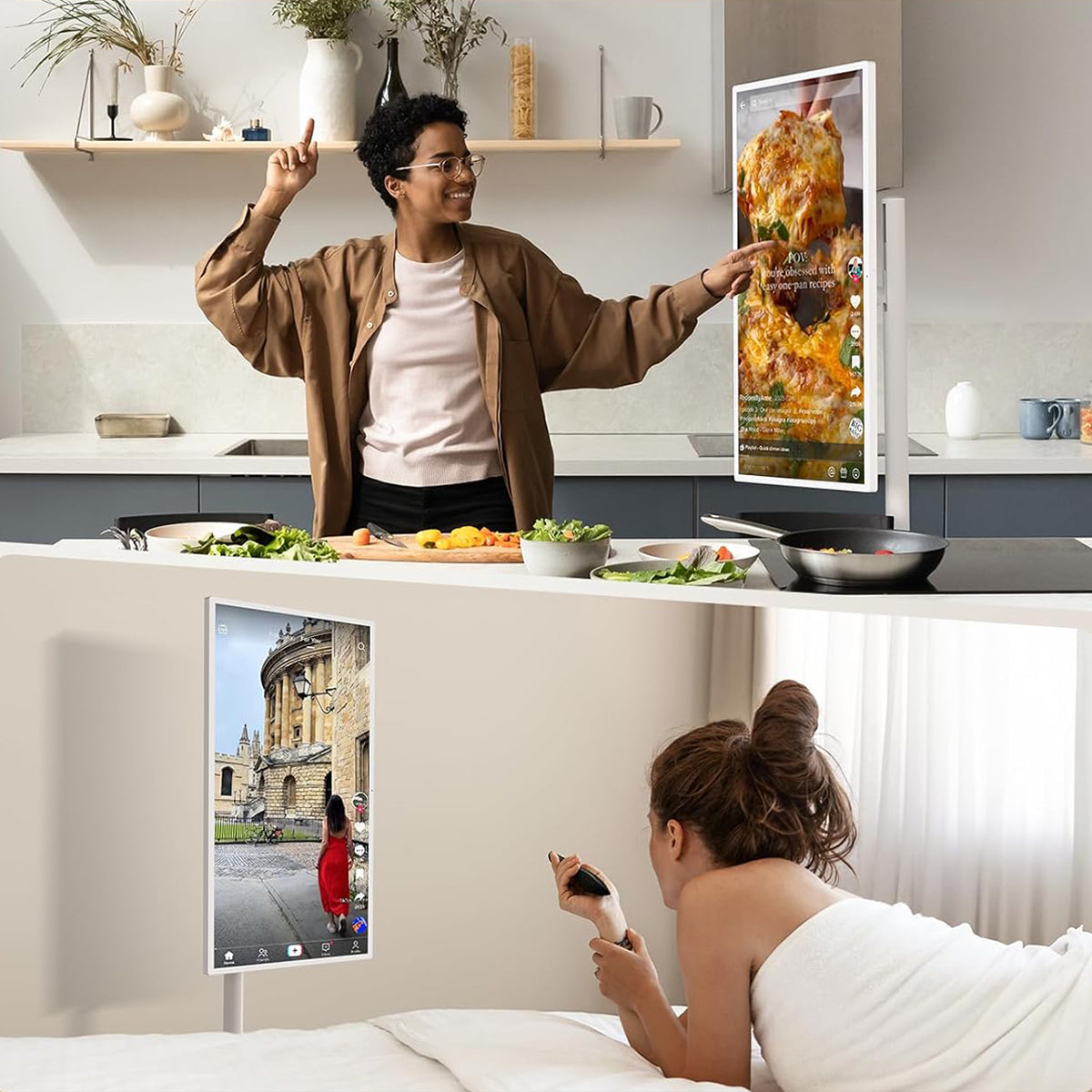
A portable screen is an all-in-one unit. Screen, speakers, smart apps, and a rolling stand, built as one piece. Many carry a battery too.
In a kitchen, that changes a lot:
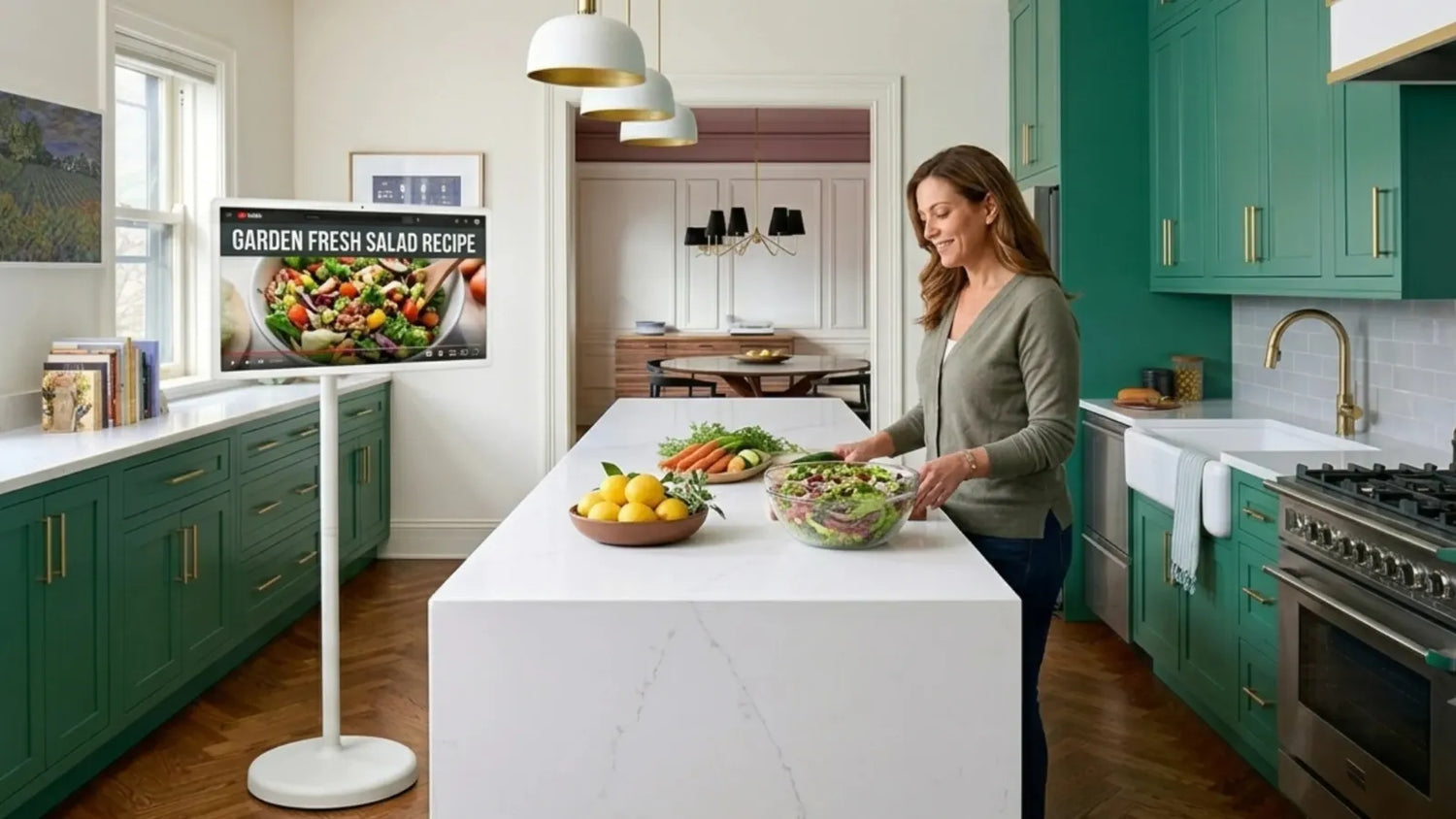
- It stands by itself, so nothing gets propped or balanced
- The screen sits at eye level, not flat on the counter
- Bigger display means you can read a recipe from the stove
- Zero counter space used, since the stand holds it
- Built-in speakers you can hear over a running tap and a sizzling pan
- Wheels, so it rolls to the sink, the island, or out of the way
- No incoming calls interrupting your video
And because it's built to be moved, it doesn't live in the kitchen full time. Cook dinner, then wheel it to the sofa. That flexibility is the whole appeal.

iPad vs. Portable Touch Screen TV in the Kitchen
Here's the honest comparison, because each one wins at different things.
Where the iPad still wins
Truly portable. It fits in a bag. A portable screen doesn't.
Cheaper, if you already own one.
Great for reading recipes up close, or scribbling a shopping list.
Drawing and note apps are more developed on tablets.
Where the portable touch screen wins
- Hands-off use. It's already standing, already on, already positioned.
- Visibility. Read from four feet away instead of two.
- Sound. Tablet speakers lose to an extractor fan every time.
- Safety. It's off the wet counter and away from the hob.
- Comfort. No hunching over a small screen for an hour.
Simple way to think about it: an iPad is a personal device you hold. A portable screen is a kitchen fixture you use. Different jobs.
How Do You Actually Use One While Cooking?
This is where it clicks, and it's easier than people expect.
Set it up before you start. Roll the screen to where you'll be working. Pull up the recipe or video first, adjust the height, then wash your hands. Now you don't touch it again until you need to.
Pause with your voice or a knuckle. Many models take voice commands. And if you do need to tap, a knuckle or the back of your wrist works fine on a big screen — try that on a tablet and you'll miss.
Rotate it for phone-shot videos. Most cooking content online is filmed vertically. A portable touch screen that spins to portrait shows it full size instead of a tiny strip.
Follow along at your own pace. Step-by-step videos are much easier when you can see the pan on screen and the pan in front of you at the same eye line.
If you make content, film with it. Food bloggers use these two ways at once: reference on screen while cooking, and a monitor for framing shots. Being able to see your own composition, hands-free, saves a lot of reshooting.
Then wheel it away. Kitchen goes back to being a kitchen.
What Should You Look For If You're Buying One?
A few things genuinely matter here:
- Screen size that fits your space. Big enough to read, small enough not to crowd.
- Battery, if you'd rather not run a cord across a kitchen floor.
- Rotation, for vertical video.
- Wipeable surfaces. Kitchens get messy.
- A stable rolling base with locking wheels.
Brands like GFF AI build their all-in-one portable screens around this kind of everyday moving — battery, touch panel, and rolling stand designed together, so you're not assembling a setup from separate parts.
FAQ
Is a portable screen safe to use near a stove?
Keep it a sensible distance from direct heat, steam, and splashes, same as any electronic. The advantage is that a rolling stand lets you position it away from the hob while still reading it easily — something a propped tablet can't do.
Can I use a portable touch screen TV with wet hands?
Better not to. But you don't need to touch it much at all, and a large screen responds fine to a knuckle or dry wrist when you do.
Is it worth it if I already own an iPad?
Depends how much you cook. Occasional cook, the tablet is fine. If you're in the kitchen most days, or filming content, the difference in comfort is real.
Do these screens work without Wi-Fi?
Most run streaming apps that need internet. Many also cast from your phone or play from a USB drive, so downloaded recipes still work offline.
Can it double as a regular TV?
Yes. That's the point of an all-in-one. Cook with it, then watch a film on it.
The Bottom Line
Propping an iPad against the kettle works right up until it doesn't. A portable touch screen TV fixes the small annoyances that add up every single time you cook — the sleeping screen, the sore neck, the sticky glass, the lost counter space.
Cook more than you'd like to admit? Take a look at the GFF AI range of portable smart screens and pick the size that suits your kitchen.