
Table of Contents
A 20,000mAh battery runs a small portable TV for roughly 4 to 8 hours on one charge. Where you land in that range depends on screen size, brightness, and what you're watching.
Turn the brightness down and stream a movie, and you'll get closer to the top of that range. Crank it up outdoors with the volume high, and you'll be nearer the bottom.
That's the quick answer. Now here's why the number moves around so much: once you understand it, you can stretch it.
What 20,000mAh Actually Means
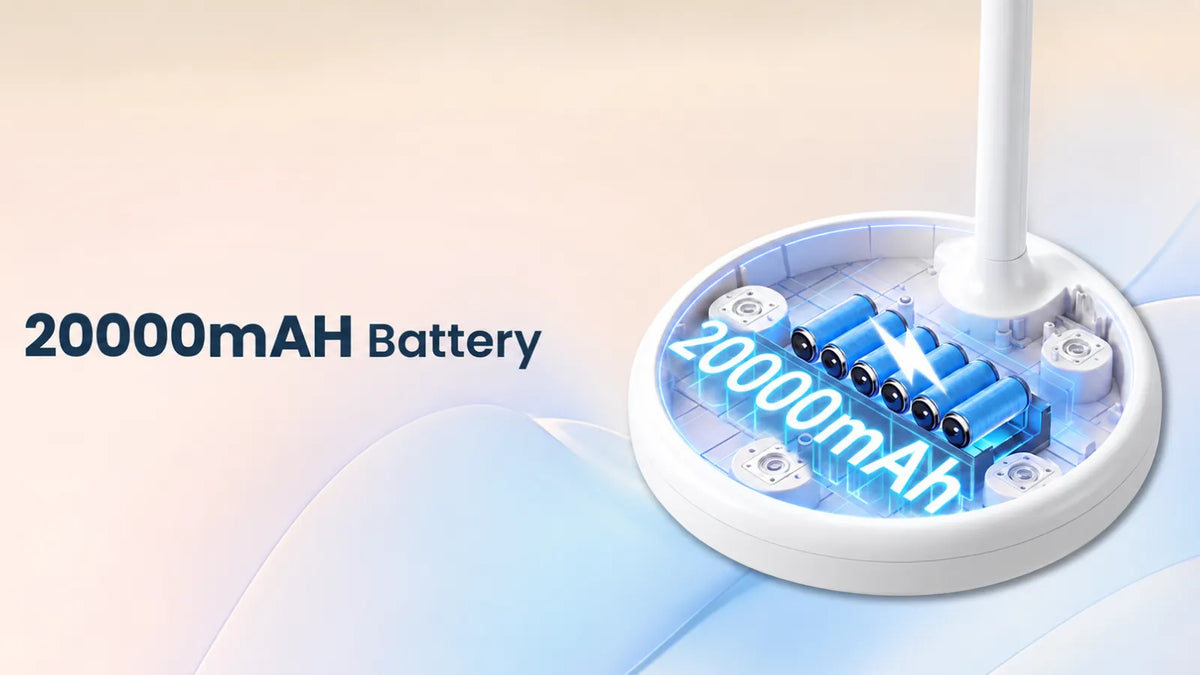
Think of mAh as the size of a fuel tank. It stands for milliamp-hours, and it tells you how much charge the battery holds. Bigger number, bigger tank.
But a tank size alone doesn't tell you how far the car goes. You also need to know how thirsty the engine is.
So there's a second number that matters more: watt-hours. To get it, you multiply the capacity by the battery's voltage. Most battery cells run at about 3.7 volts, which means:
20,000mAh × 3.7V ÷ 1,000 = about 74 watt-hours
That's your real fuel gauge. And once you know a screen's power draw in watts, the runtime becomes simple division.

The Rough Math on Runtime
Here's how 74 watt-hours plays out at different power levels:
- Drawing 10 watts: around 7 hours
- Drawing 15 watts: around 5 hours
- Drawing 20 watts: around 3.5 to 4 hours
- Drawing 30 watts: around 2.5 hours
One catch. No battery delivers 100% of what it holds, since some energy is lost as heat during conversion. Shave off roughly 10% to 15%, and you'll have a realistic figure.
Now, a normal 32-inch LED TV plugged into a wall usually pulls somewhere between 30 and 50 watts. That would drain 74 watt-hours in under two hours, which clearly isn't what battery-powered screens deliver. Why the gap? Because portable models are tuned differently.
They run at lower brightness, use more efficient panels, and use power-saving chips, so they often sit closer to 10 to 15 watts in normal use. That's how you get most of a day out of one charge.
What Affects Portable TV Battery Life?
Battery life isn't one fixed number. These are the things that move it, ranked roughly by how much impact they have.
Brightness
This is the big one. The backlight is usually the hungriest part of the whole device. Dropping from full brightness to about 50% can add an hour or two, and indoors you probably won't miss it.
Screen size and resolution
More pixels need more power. A 32-inch 4K screen works harder than a 22-inch 1080p one, so the same battery won't stretch as far. That's worth remembering when you're comparing two models with identical mAh ratings.
Volume
Speakers draw real power, especially outdoors when you push them loud to beat the wind. Bluetooth headphones or a small speaker will often save you battery, not cost it.
What you're actually doing
Streaming keeps the Wi-Fi chip busy the whole time, so it uses more than playing a file stored on the device. Gaming and video calls are hungrier still, since the processor and camera are both working. Leaving it on a photo slideshow, on the other hand, barely touches the battery.
Temperature
Cold weather makes batteries sluggish, and heat wears them down faster. A screen left baking in direct sun on a patio will run down quicker than one in a shaded kitchen.
Battery age
All lithium batteries fade. After a couple of years of regular charging, expect somewhat less runtime than you got on day one. That's normal, not a fault.
If you want to dig into how brightness and picture settings affect power use in general, ENERGY STAR's television guidance is a solid, non-commercial starting point.
A Real Example: the GFF S2
Numbers make more sense with an actual product attached, so let's use one. The GFF S2 is a 32-inch 4K portable smart TV on a rolling stand, and it packs a 20,000mAh battery rated for up to 8 hours of use. It also ships with a 90W fast charger, which matters more than people expect. A big battery is only convenient if it refills quickly.
So what should you really expect from it?
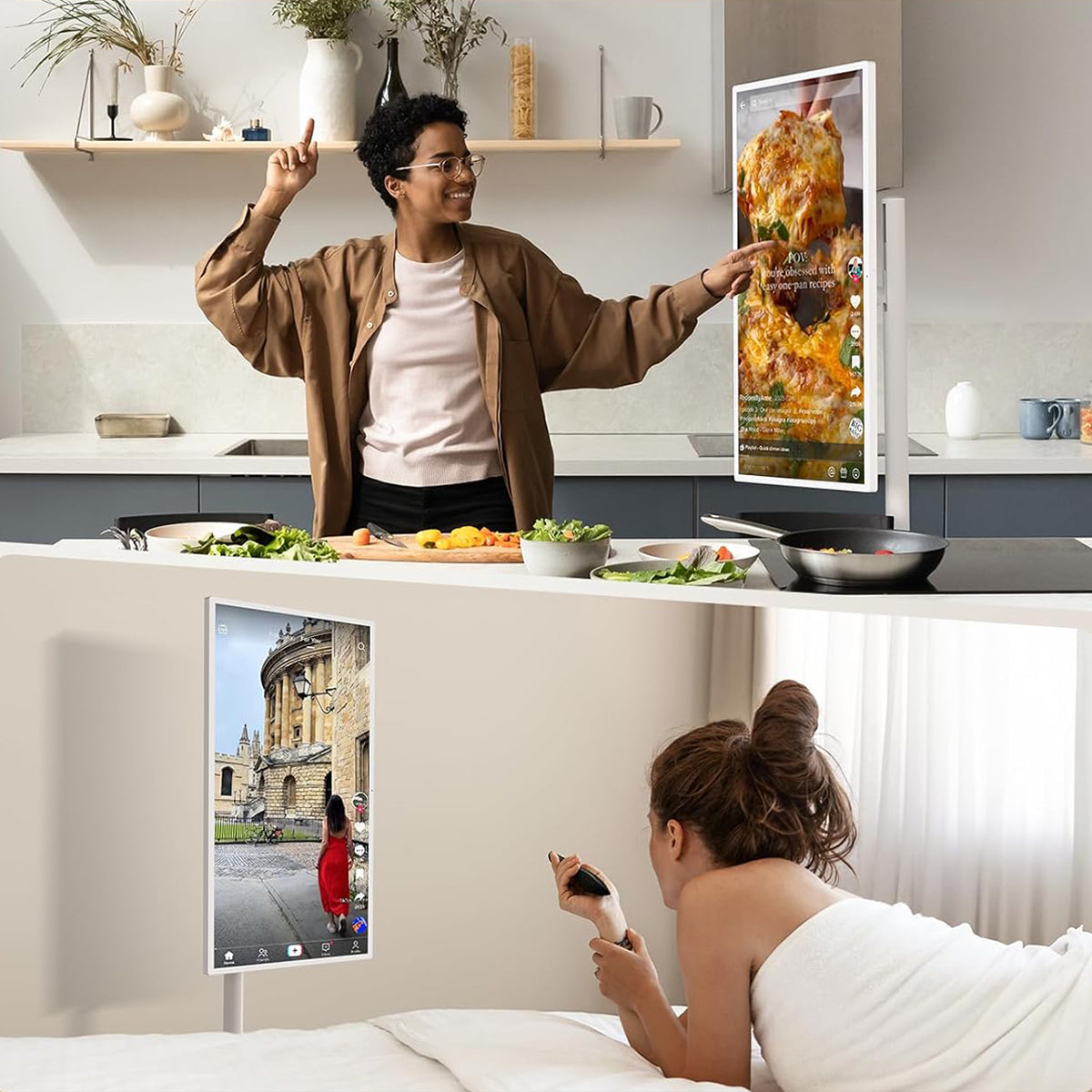
- Kitchen use, moderate brightness, streaming recipes: comfortably 6 to 8 hours
- Movie night at normal brightness with the volume up: roughly 5 to 6 hours
- Outdoors at full brightness, loud, in the sun: closer to 4 hours
Manufacturer figures are always measured under ideal conditions, and that applies across the whole category, not just to GFF AI. Treat "up to 8 hours" as the ceiling rather than the average.
Even at the low end, though, a 20,000mAh screen outlasts most rivals. Plenty of portable TVs ship with 8,000 to 10,000mAh, which is half the tank.

Simple ways to get more hours
Small habits add up:
- Drop the brightness to somewhere between 40% and 60%
- Use headphones or a Bluetooth speaker instead of loud built-in audio
- Download shows ahead of time rather than streaming them
- Close background apps before you unplug
- Keep it out of direct sunlight
- Top it up before it hits zero, since deep drains age batteries faster
FAQs
1. How long does a 20,000mAh battery last on a portable TV?
About 4 to 8 hours for most models. A 20,000mAh battery holds roughly 74 watt-hours, and a typical portable TV draws around 10 to 20 watts, which lands you in that window.
2. Is 20,000mAh good for a portable TV?
Yes, it's near the top end of the category. Many portable TVs use 8,000 to 15,000mAh batteries, so 20,000mAh usually means a few extra hours away from a socket.
3. Does screen size change how long the battery lasts?
Yes. Bigger screens with more pixels need more power, so a 32-inch 4K model will drain a battery faster than a 22-inch 1080p one with the same capacity.
4. How long does a 20,000mAh portable TV take to charge?
It depends on the charger. With a 90W fast charger like the one included with the GFF S2, expect a couple of hours. With a slow charger, it can take considerably longer.
5. Can I use it while it's charging?
Yes, on nearly every model. It just charges more slowly, since some of the incoming power is going straight to the screen.
The bottom line
A 20,000mAh battery is a genuinely useful amount of power. It's the difference between a screen that follows you around all day and one that's always hunting for an outlet.
Just remember the real number behind it, roughly 74 watt-hours, and that brightness is the dial with the biggest effect.
Want a portable TV that actually lasts? Check out the GFF S2 on Amazon, with its 20,000mAh battery and 90W fast charger, and see how long you can go without plugging in.