

Table of Contents
Go furniture shopping for a TV stand, and you'll quickly notice something odd: none of them look alike. One's low and boxy with cabinet doors. Another is bolted to the wall with nothing touching the floor. Someone, somewhere, decided to put a fireplace inside one. It's a lot to sort through when all you wanted was somewhere to put your TV.
Here's the thing, though, once you understand what each type is actually built for, picking one gets a lot less confusing. So let's go through the main types of TV stands you'll come across, how they got here, and what actually matters when you're choosing.
How TV Stands Got Here
If you grew up with a boxy tube TV, you probably remember the TV console that came with it, a heavy wood cabinet built to support something that weighed almost as much as a washing machine. Function over everything.
Flat screens changed the math completely. TVs got lighter, thinner, and honestly, kind of beautiful to look at, so the furniture holding them started to change too. Instead of one clunky design, we ended up with a bunch of different styles built around different priorities: some for saving space, some for hiding cords, some just for looking good next to a modern TV.
The Main Types of TV Stands
Traditional TV stand
These are the ones with closed cabinets, solid wood, maybe a few drawers. If you like things tucked away and out of sight, this is probably your style. They tend to look right at home in farmhouses or classic interiors, and they're usually built to last.

Corner TV stand
Angled to tuck into a corner instead of sitting flat against a wall. Honestly underrated, if you've got a small living room or a bedroom where space is tight, a corner tv stand can free up more room than you'd expect.

Floating TV stand
No legs, no base, just mounted straight to the wall. These give a room a cleaner, almost weightless look, and because there's open floor space underneath, smaller rooms tend to feel bigger with one installed.
TV Stand with Fireplace
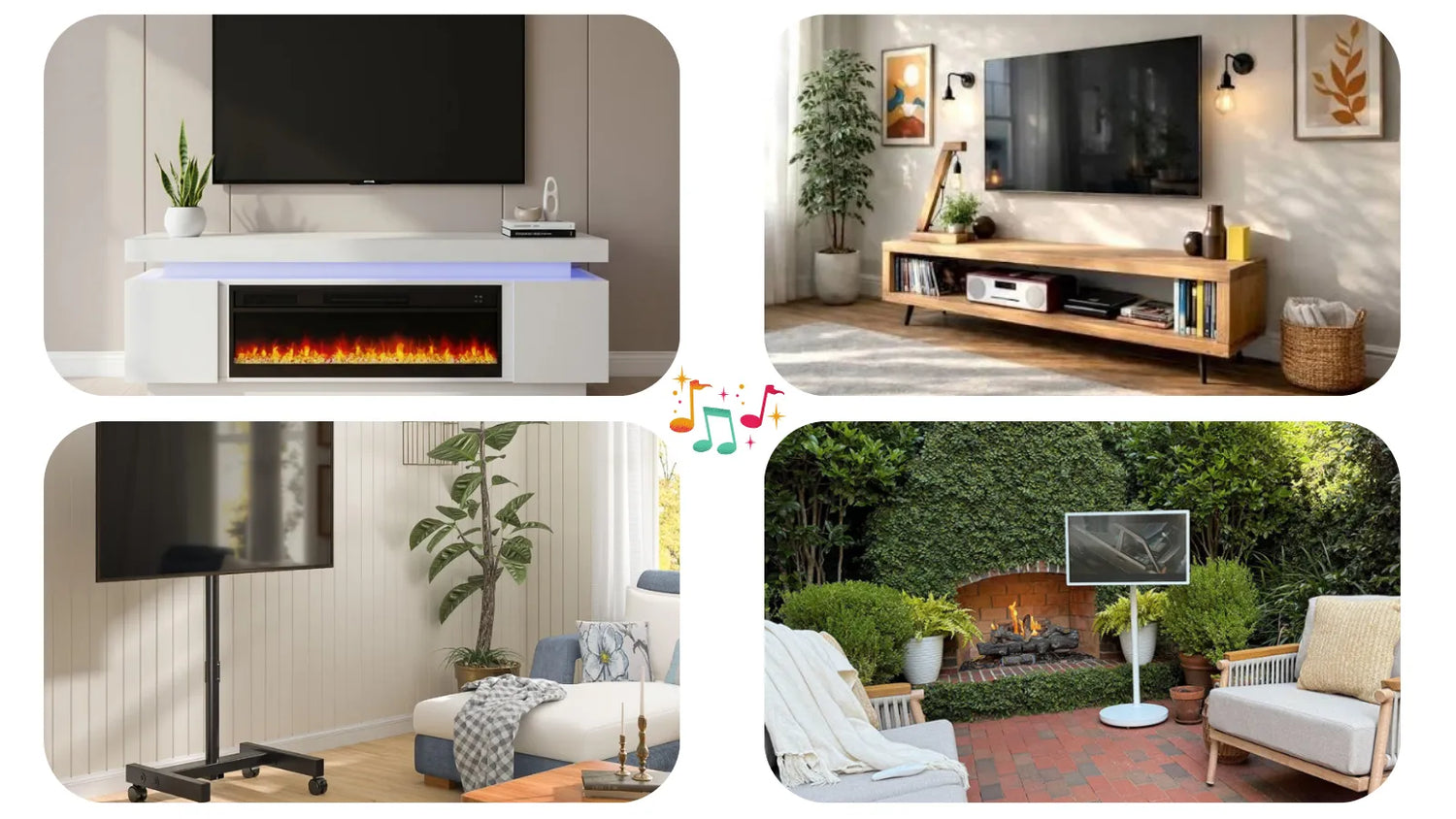
Part storage, part heater, part mood lighting. A fireplace tv stand does double duty, it holds the TV and becomes the actual focal point of the room, especially once it gets cold out and you flip the flame effect on.

Rolling TV stand
Exactly what it sounds like, wheels on the bottom so you can push it wherever you need it. Great for dorms, offices, or anyone who rearranges their living room more than twice a year.

Glass TV stands
Sleek, minimal, see-through shelving. They don't visually "take up space" the way a solid wood stand does, which makes them a good pick for smaller or more modern apartments.
Mid-century modern TV stands
Tapered wooden legs, low profile, clean lines, this style never really went away and it's back in a big way. Pairs nicely with warm tones and retro-leaning decor.
None of these is objectively "the best TV stand." They're just built to solve different problems. A rolling stand is for people who need flexibility. A fireplace stand is for people who want ambiance. Once you know your own priority, the choice practically makes itself.
How to Choose the Right TV Stand
Okay, so you've got a sense of the styles. Now for the part that actually matters day-to-day.
Size first, always
This is where most people mess up: they buy a stand without really measuring anything. A good rule of thumb: your stand should run about 6 to 12 inches wider than your TV on each side. So if you've got a 55-inch TV, don't grab a stand that barely fits it, give it a little room to breathe visually.
Height matters just as much. For the best viewing experience, the middle of the screen should land roughly at eye level when you're sitting down. A lot of stands are built to put the TV around 42 inches off the floor, but honestly, this depends on your couch and how far back you sit.
Be honest about your storage needs
Do you have a gaming console, a soundbar, a streaming box, and a drawer full of old cables you swear you'll organize someday? Or do you genuinely just want a flat surface and nothing else?
- Closed cabinets are great if you want everything hidden
- Open shelves make grabbing a remote or console easy
- Drawers work well for smaller stuff like controllers
- Built-in hidden storage keeps the outside looking clean while everything's tucked away inside
Don't skip cable management
A gorgeous stand can look messy in about ten seconds flat if there's a nest of cords hanging out behind it. Look for stands with cutouts or channels built into the back panel, it's a small detail, but it makes the whole setup look ten times more put-together.
Match your room, not a trend
A stand with clean modern lines can look strangely out of place in a cozy, traditional living room. And a heavy traditional console can feel clunky in a bright, minimal apartment. Look at what you already own before you buy, the stand should support the room, not fight it.
Figure out how it's actually going to hold the TV
Some stands are built for the TV to sit right on top. Others are meant to pair with a wall mount, where the stand is just there for storage underneath. If you're planning to mount the TV on the wall, you probably want something shorter that's purely for media devices.
Common Questions
1. What size TV stand fits a 55-inch TV?
Somewhere around 55 to 65 inches wide usually works well, enough to support the TV without looking cramped.
2. Are floating TV stands actually safe for a heavy TV?
Yes, as long as it's mounted into wall studs and rated for the combined weight of the TV and anything sitting on it.
3. Do fireplace TV stands put out real heat?
Most of them do. It's not just a flame effect; many models genuinely warm a room, which is a nice bonus in winter.
4. What works best in a small apartment?
A corner tv stand or a floating one, generally. Both are built specifically to save floor space.
5. How far away should I sit from the TV?
A common guideline is about 1.5 to 2.5 times the screen's diagonal size. For a 55-inch TV, that puts you roughly 7 to 11 feet back.
Final Thoughts
At the end of the day, choosing a TV stand isn't complicated once you know what to look for. Measure your TV, think honestly about how much you need to store, and be real with yourself about your room's style. Whether you end up with a rustic wood console, a floating minimalist shelf, or a fireplace stand that doubles as the room's centerpiece, there's a version built for exactly what you need.
Take a look around your living room before you shop. Once you know what you're actually solving for, finding the right one stops feeling like a chore.